ABOUT
How can the human body be present in artistic practice without being explicitly depicted?
Jule Tabea Martin is a contemporary artist based in Berlin and the Rhine-Neckar region. Rooted in sculpture, her practice extends into installation and drawing.
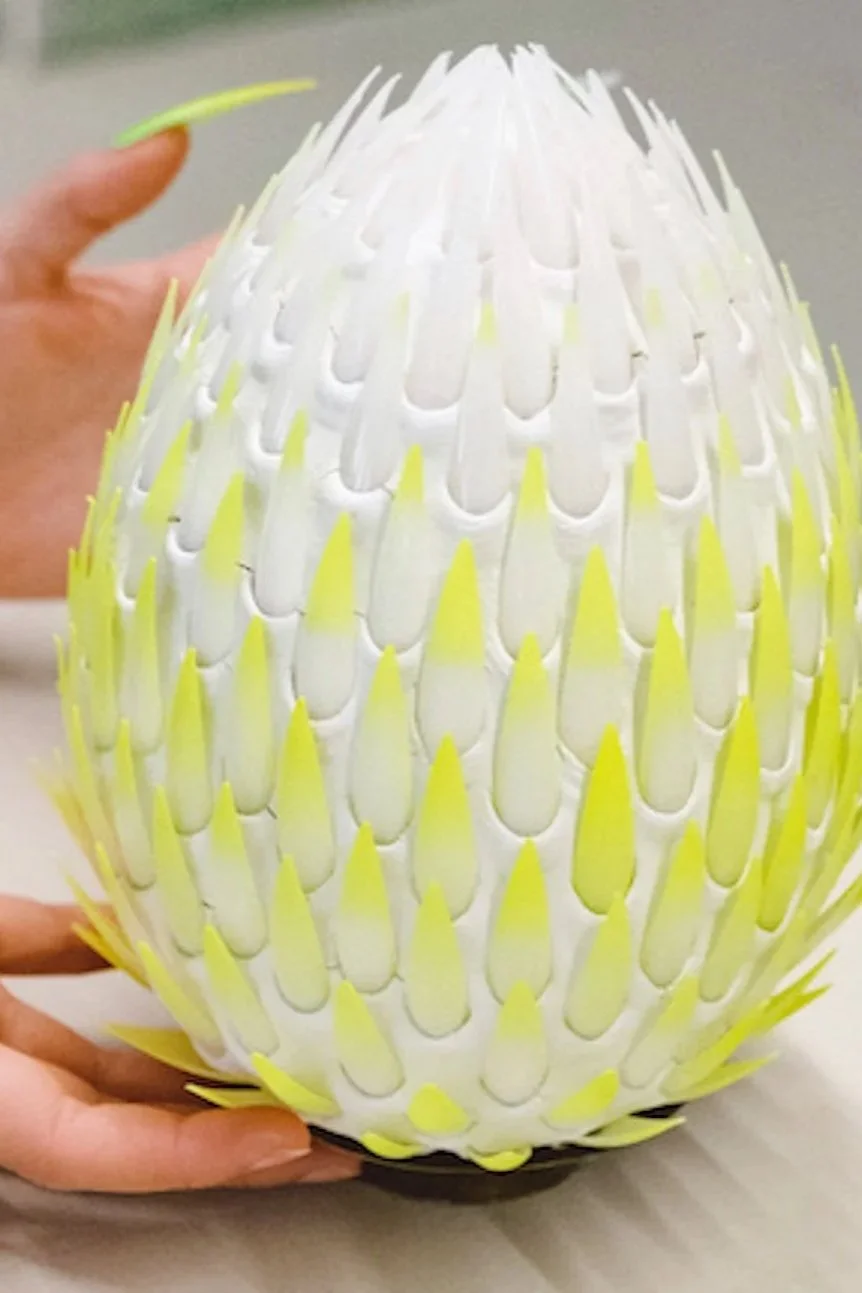
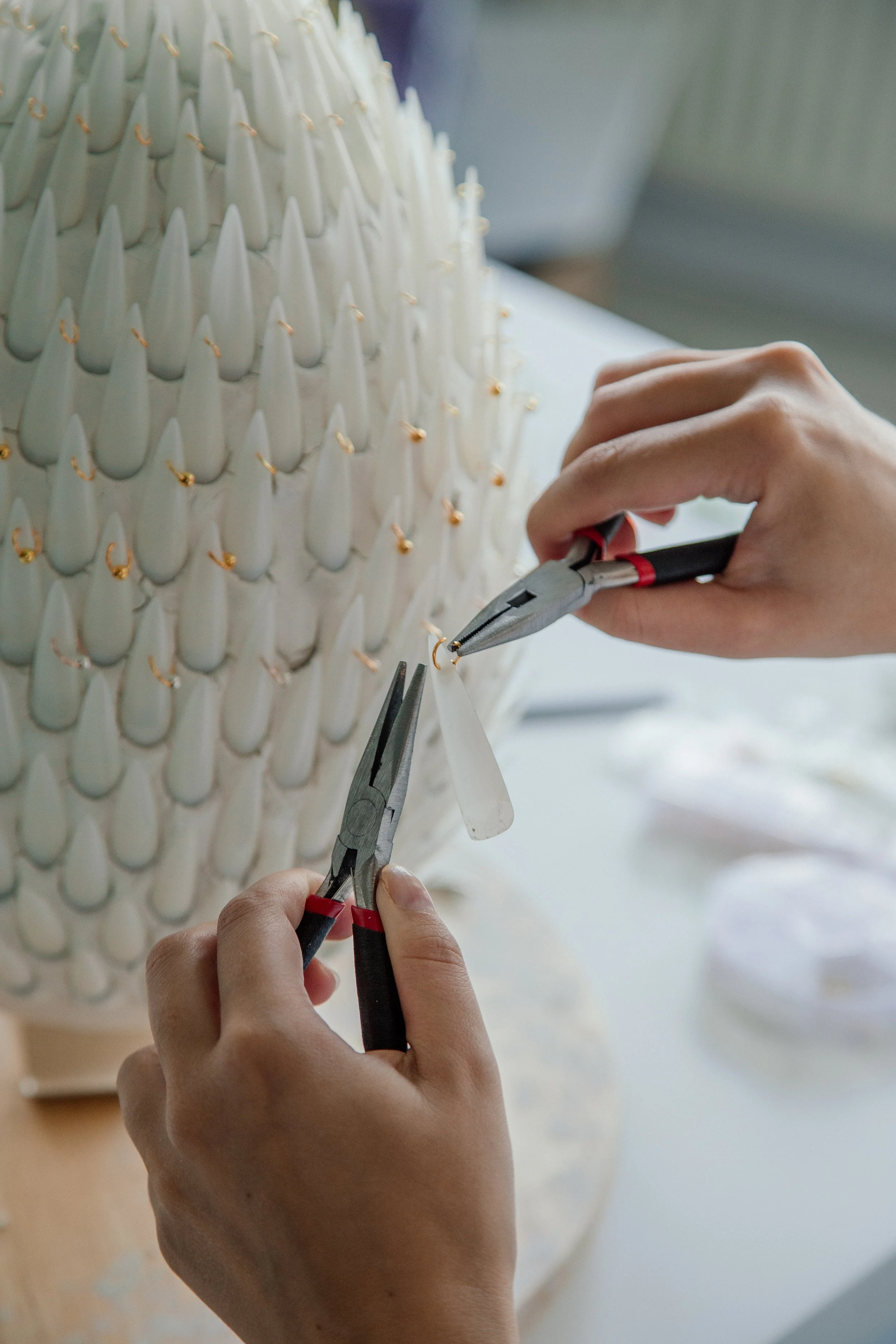
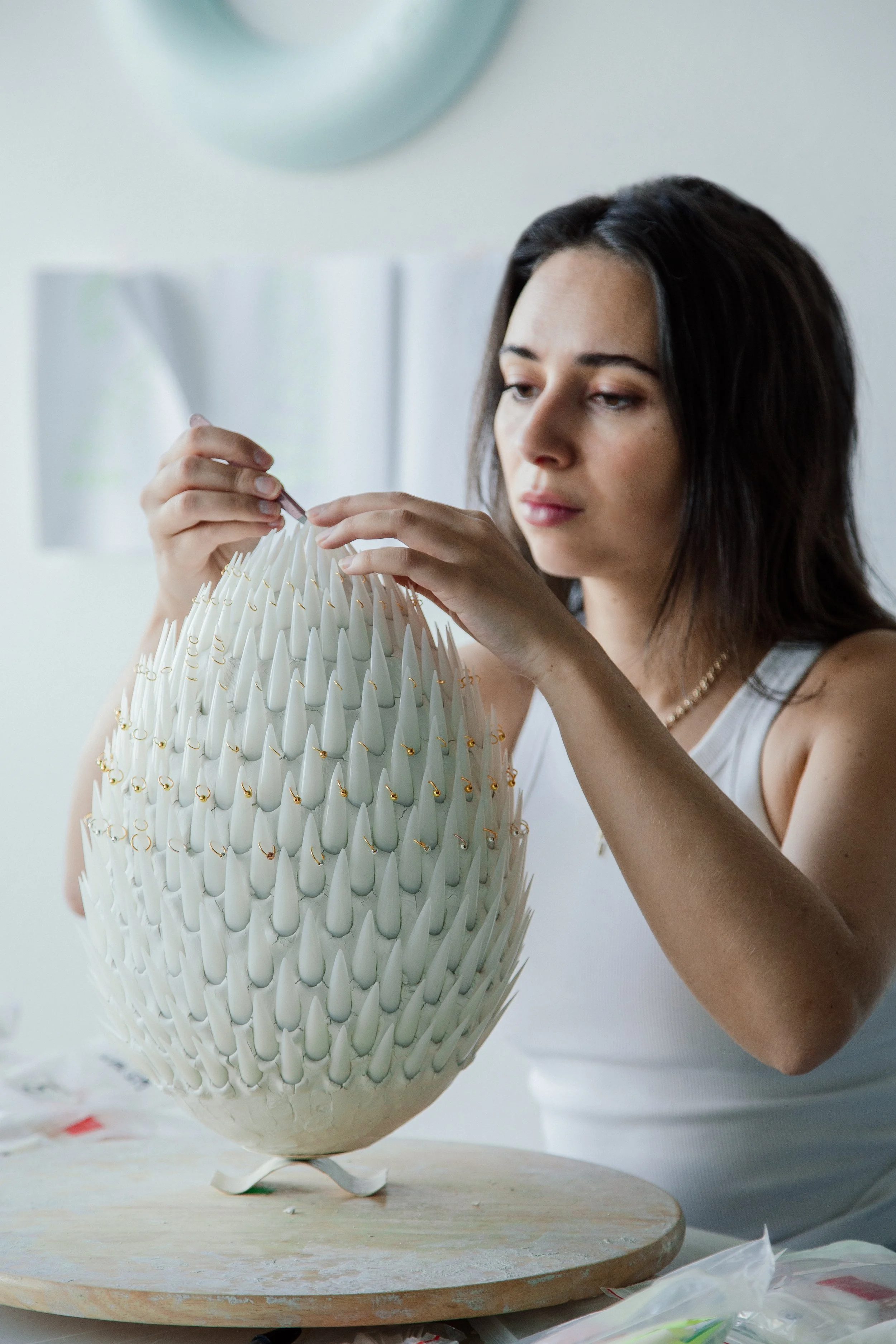
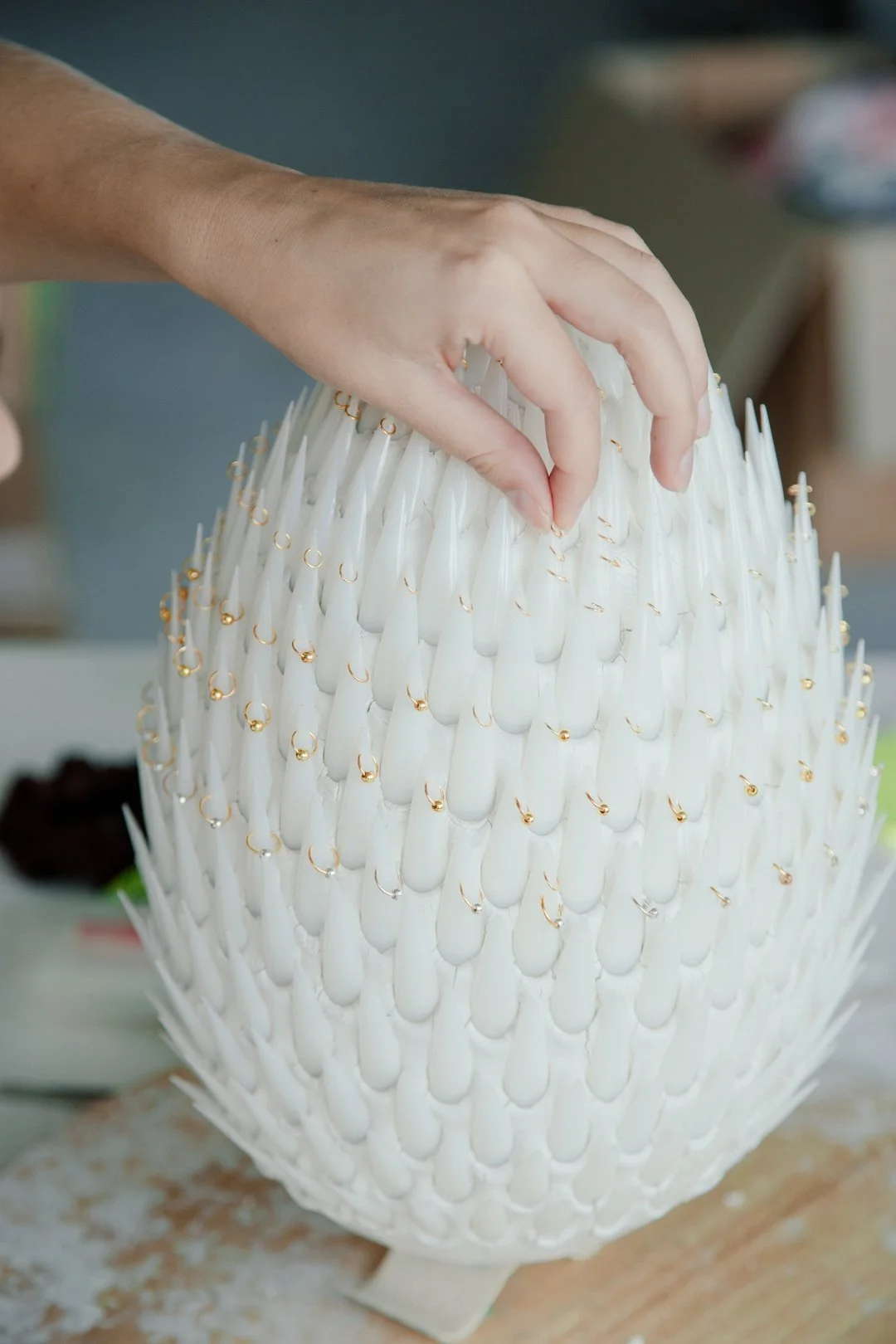
In her practice, she engages with the human body — not in its direct physical presence, but as absence, trace, and cultural construction. She uses objects that function as extensions and substitutes of the body: artificial fingernails and real hair extensions. With these materials — often regarded as trivial symbols of hyper-feminine corporeality — Martin explores how socially normative images of the body, in their fragile and stereotypical constructions of gender, can be deconstructed through material and translated into ornamental form.
Her work addresses societal attitudes toward beauty ideals, body optimization, and the economization of self-images. These materials become carriers of complex and often contradictory meanings: they are simultaneously expressions of self-empowerment and signs of conformity, of desire production and exploitation.
SELECTED EXHIBITION TEXTS (ENG)
German version below
-
Jule Tabea Martin ties knots. For hours, in an almost meditative state, she ties strand after strand until nearly 1,000 micro-ring extensions form a curtain, a fabric — her interpretation of the previously removed goal net. Two goals stand facing each other in dialogue on a self-defined playing field of green rolled turf, creating a sense of irritation. Instead of the familiar white nylon netting, countless copper-red vertical strands of hair sway in the airflow of a large fan.
In her solo exhibition Power Shot, the artist once again addresses the humanisation of objects, raising questions about their vitality, subjectivity, and gendered nature. Human hair extensions are among the primary materials used in Jule Tabea Martin's installation-based works.
In her works inspired by sports equipment, she engages with ball sports such as basketball and table tennis. In the exhibition Power Shot, she turns her focus to the football goal — once again centring a male-dominated sport. Yet it is not the sport itself that sparked her interest — it is the net.
The net, which Martin explores in various ways throughout her artistic practice, also serves as a metaphor for human emotional life. It carries a tension-laden, contradictory dynamic: on the one hand, the net evokes the association of being trapped; on the other, it provides the assurance of being caught. In sport, too, the net holds an ambivalent character: in tennis, a ball landing in the net can signify defeat, while in football, sinking the ball into the opponent's net signals victory.
Jule Tabea Martin abstracts the traditionally woven net, rendering it linear, dispensing with horizontal knots, and thereby granting it greater lightness and permeability — qualities further enhanced by the texture of the hair.
Through the incorporation of long strands of human hair, the football goal — an object primarily coded as masculine within European culture — becomes humanised, or more precisely, feminised. The hair originates from people, predominantly women, in Southeast Asia. They cut their hair and sell it for very little money. It is bleached and straightened, only to be chemically re-dyed in a standardised colour palette. The finished product — the coveted strands — travels to the other end of the world, primarily to fulfil the beauty ideal of full, long hair in Western societies.
The supposed naturalness implied by the term "real hair" does not withstand scrutiny, as the chemical processes involved in its treatment negate any previously existing naturalness once found in the hair donor. Hair, as a self-reproducing human resource, is harvested in order to be consumed elsewhere in the form of hair extensions.
The artist subjectifies her goals through a human "waste product" that arouses the desire of many while simultaneously embodying the exploitative side of the obsession with beauty. The red strands point to this absurdity just as much as they highlight the aesthetic quality of the material. Hair has always been a compelling subject in visual representation, conveying sensuality and frequently being sexualised in art. Martin also displays humour when she gives the goals a fringe. She treats the goals like heads, styling each one differently, thereby further emphasising their individualisation. This also reveals her pleasure in experimenting with the material.
Coming from drawing practice and theory, the strands of hair also represent a significant formalist element for Jule Tabea Martin. The fine hairs appear as lines translated from the two-dimensional into the three-dimensional, thus revealing their stroke-like, graphic quality.
Valerie Ucke, Curator at the State Museum Wiesbaden (Landesmuseum Wiesbaden)
-
The female body as a logical extension of the object repertoire formed, among other things, the starting point for the artistic explorations of Body Art practitioners within the feminist avant-garde of the 1970s. In the works of Jule Tabea Martin, it is no longer the (own) body that stands in the foreground as a surface for experimentation, but rather its substitutes: hair and fingernails.
In choosing to work with human hair extensions and artificial nails, the artist opts for artificial and temporary extensions of the body — products that offer their users the possibility of active self-optimisation and modulation. Decontextualised from their characteristic use, these materials by no means represent only those read as female; they simultaneously act as proxies for human existence.
For the work presented at Kunsthalle Mainz, the artist carefully tied together long blonde and black strands of hair to form basketball hoops. Attached to a ring and mounted on red acrylic glass, the hoops — standardised in size and made from human hair — refer, through their function in athletic activity, to actual relations to the human body.
The net of hair, which would gradually dissolve during active play with a ball, forms a reference to the fragile constructs of gender identities, human existence, and processes of transformation — and calls them into question.
Bettina Löwen, Assistant Curator at the State Museum Wiesbaden (Landesmuseum Wiesbaden)
Ausgewählte Ausstellungstexte (GER)
-
Jule Tabea Martin knüpft. Stundenlang, in fast meditativem Zustand, knüpft sie Strähne für Strähne, bis aus den knapp 1.000 Microring-Extensions ein Vorhang, ein Gewebe, ihre Interpretation des zuvor abgehangenen Tornetzes entsteht. Zwei Tore stehen sich dialogisch auf einem selbstdefinierten Spielfeld aus grünem Rollrasen gegenüber und irritieren. Statt mit dem vertraut weißen Nylonnetz bespannt, bewegen sich an dessen Stelle unzählige kupferrote vertikale Haarsträhnen im Luftzug eines großen Ventilators.
In ihrer Einzelausstellung Power Shot thematisiert die Künstlerin erneut die Humanisierung von Objekten und stellt die Frage nach deren Vitalität, Subjektivität und Geschlechtlichkeit. Echthaar-Extensions gehören in den installativen Arbeiten von Jule Tabea Martin zu den vornehmlich verwendeten Materialien.
Sie verhandelt in ihren von Sportutensilien inspirierten Werken Ballsportarten wie Basketball oder Tischtennis. In der Ausstellung Power Shot nimmt sie mit dem Fußballtor erneut eine männlich dominierte Sportart in den Fokus. Doch ist es nicht der Sport per se, der ihr Interesse geweckt hat – es ist das Netz.
Das Netz, das Martin auf unterschiedliche Weise in ihrer künstlerischen Praxis erforscht, versteht sie auch als eine Metapher des menschlichen Gefühlslebens. Zudem beinhaltet es eine spannungsgeladene, widersprüchliche Dynamik: einerseits weckt das Netz die Assoziation des Gefangenseins, an anderer Stelle sorgt es dafür aufgefangen zu werden. Auch im Sport hat das Netz einen ambivalenten Charakter: während im Tennis ein im Netz gelandeter Ball eine Niederlage bedeuten kann, sind es im Fußball siegreiche Aussichten, wenn der Ball im Netz des gegnerischen Tores versenkt wird.
Jule Tabea Martin abstrahiert das klassisch gesponnene Netz, lässt es linear werden, verzichtet auf die horizontalen Knotenpunkte und schenkt ihm dadurch mehr Leichtigkeit und Durchlässigkeit, was zusätzlich durch die Textur der Haare unterstützt wird.
Durch die Implementierung der langen Strähnen aus Echthaar wird das Fußballtor, das im europäischen Kulturraum primär männlich konnotiert ist, vermenschlicht, genauer gesagt verweiblicht. Die Haare stammen von Menschen (überwiegend Frauen) aus Südostasien. Sie schneiden sich ihr Haar, verkaufen es für wenig Geld. Es wird gebleicht und geglättet, nur um anschließend wieder chemisch in einer standardisierten Farbpalette eingefärbt zu werden. Das fertige Produkt, die begehrten Strähnen, reisen zum anderen Ende der Welt, um vornehmlich in westlich geprägten Gesellschaften das Schönheitsideal von vollem langem Haar zu erfüllen.
Die vermeintliche Natürlichkeit, die in dem Begriff Echthaar steckt, hält einer Hinterfragung nicht stand, denn die chemischen Prozesse der Verarbeitung negieren jegliche zuvor vorhandene Natürlichkeit, wie sie bei der Haarspenderin vorzufinden war. Das Haar, als eine menschliche, sich reproduzierende Ressource, wird geerntet, um in Form von Haarverlängerungen an anderer Stelle konsumiert zu werden.
Die Künstlerin subjektiviert ihre Tore durch ein menschliches „Abfallprodukt", das die Begehrlichkeit vieler weckt und zugleich die ausbeuterische Seite des Schönheitswahns verkörpert. Auf diese Absurdität verweisen die roten Strähnen ebenso wie auf die ästhetische Qualität des Materials. Als Bildgegenstand schon immer reizvoll gewesen, vermitteln Haare Sinnlichkeit und wurden auch in der Kunst häufig sexualisiert. Martin wird zugleich humorvoll, wenn sie den Toren eine Ponyfrisur verpasst. Sie behandelt die Tore wie Köpfe, die sie unterschiedlich frisiert und dadurch deren Individualisierung nochmal hervorhebt. Es zeigt zudem ihre Lust am Experiment mit dem Material.
Aus der Zeichenpraxis sowie -theorie kommend, stellen die Haarsträhnen auch ein bedeutendes formalistisches Element für Jule Tabea Martin dar. Die feinen Haare wirken, wie aus dem Zweidimensionalen ins Dreidimensionale übersetzte Linien und offenbaren dadurch ihre strichhafte, zeichnerische Qualität.
Valerie Ucke, Kuratorin Landesmuseum Wiesbaden
-
Der weibliche Körper als logische Fortsetzung des Objektrepertoires bildete unter anderem den Ausgangspunkt für die künstlerische Auseinandersetzung von Body Art-Künstlerinnen der feministischen Avantgarde der 1970er Jahre. In den Arbeiten von Jule Tabea Martin steht nicht mehr der (eigene) Körper als Experimentierfläche im Vordergrund, sondern Substitute dessen: Haare und Fingernägel.
Mit dem Erwerb von Echthaar-Extensions und künstlichen Nägeln fällt die Wahl der Künstlerin auf artifizielle und temporäre Erweiterungen des Körpers, die den Nutzer:innen die Möglichkeit einer aktiven Selbstoptimierung und Modulation offerieren. Aus ihrer charakteristischen Verwendung dekontextualisiert, repräsentieren diese Materialien keineswegs nur weiblich gelesene Personen, sondern agieren zugleich als Stellvertreter der menschlichen Existenz.
Für die in der Kunsthalle Mainz präsentierte Arbeit knüpfte die Künstlerin sorgfältig lange blonde und schwarze Haarsträhnen zusammen, die Basketballkörbe formen. An einem Ring befestigt und auf rotem Acrylglas montiert, verweisen die Körbe in standardisierter Größe in ihrer Materialität aus menschlichem Haar durch ihre Funktion der sportlichen Betätigung auf tatsächliche Relationen zum Menschen.
Das Netz aus Haaren, das sich im aktiven Spiel mit einem Ball sukzessive auflösen würde, bildet eine Referenz zu den fragilen Konstrukten von Geschlechtsidentitäten, Menschsein sowie Transformationsprozessen und stellt sie zur Disposition.
Bettina Löwen, kuratorische Assistenz, Landesmuseum Wiesbaden